
The Power of the Pause: Where Is the Learning Hiding?
Sep 4, 2026
Walk into almost any early years setting and you will see learning taking place.
Children building, painting, investigating, sharing books, exploring outdoors and becoming absorbed in carefully considered experiences. Practitioners are thinking about what children need to learn next, how the environment supports their development and how they can extend children’s thinking.
But what about everything that happens in between?
Putting belongings away.
Washing hands.
Preparing for lunch.
Putting on a coat.
Getting ready to go into the garden.
Making a bed.
Tidying away.
Clearing a plate.
Finding a missing shoe.
Moving from one part of the nursery to another.
How often do we see these moments as part of the curriculum?
And how often do we simply try to get through them?
When the Routine Becomes Transactional
Recently, I have written about the opportunities presented by mealtimes and challenged us to think beyond seeing lunch as something that needs to be completed before the next part of the day can begin.
The more I have reflected on this, the more I have wondered whether the same principle applies much more widely.
Have parts of the nursery day become transactional?
We need to get everybody’s hands washed.
We need to get the beds made.
We need to get everyone outside.
We need to tidy the room.
We need to get coats on.
Of course, these things need to happen. A busy early years setting has routines for good reason. Children need predictability, teams need organisation and there are important considerations around safety, hygiene and children’s wellbeing.
The question isn’t whether we should have routines.
The question is whether, in our drive to complete them efficiently, we sometimes overlook the learning happening within them.
What Happens If We Pause?
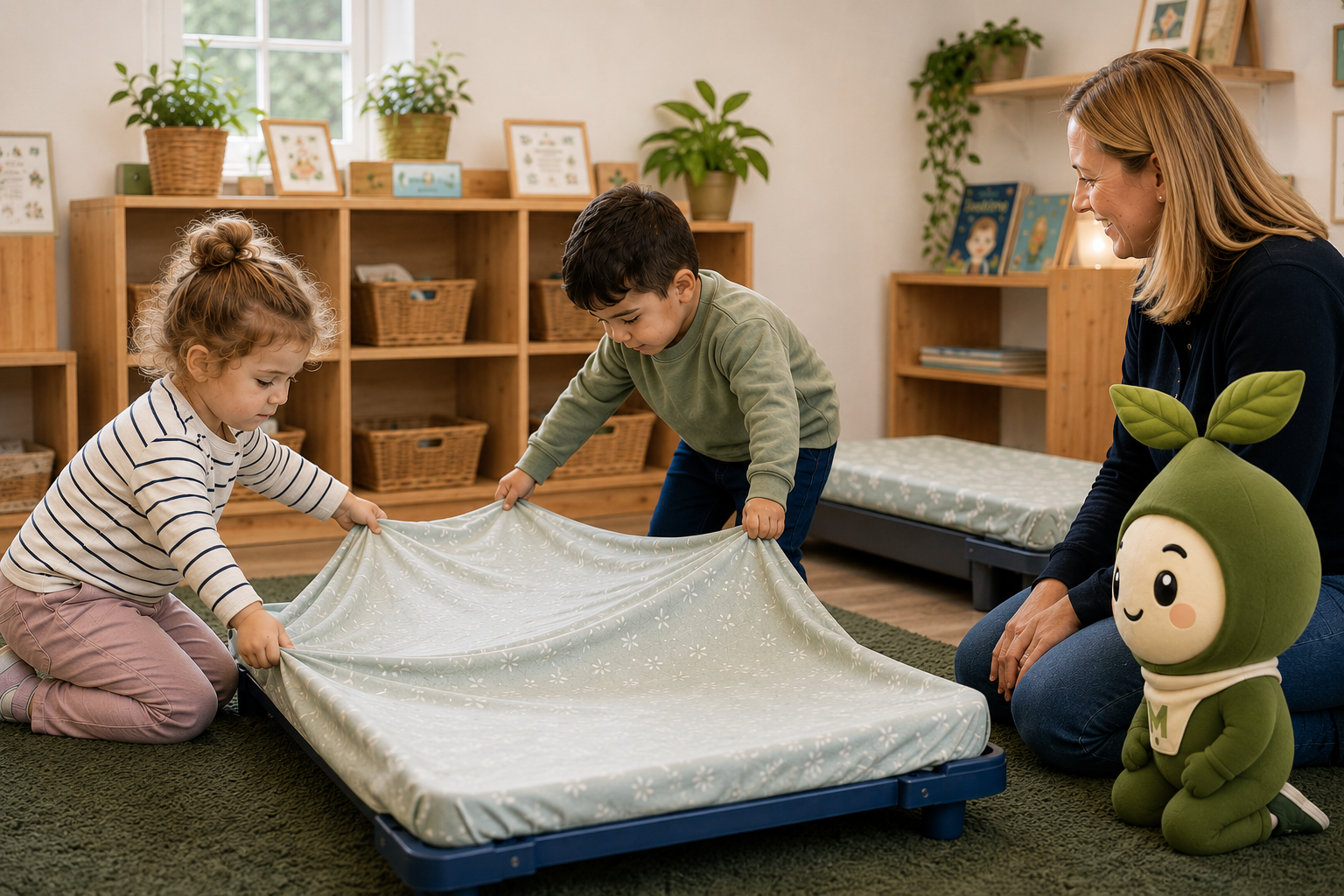
Imagine a practitioner preparing the sleep area.
There are several beds to make and lunch is nearly finished. The quickest option is obvious: make the beds while the children are occupied elsewhere.
Now imagine doing something slightly different.
A child carries their bedding to their bed. They unfold the sheet and try to work out which way it goes. They pull one corner over the mattress and it slips off when they move to the other side.
The adult could immediately step in.
But what happens if they pause?
The child tries again.
They change the way they are holding the sheet.
Another child notices and holds one side.
They work together.
There is physical coordination, spatial awareness, problem-solving, communication, collaboration, perseverance and independence happening in a task that could easily have been completed by an adult in seconds.
The bed may not be made perfectly.
But perhaps that wasn’t the most important outcome.
Participation Before Independence
There can sometimes be a tendency to think about independence as the end point.
Can the child do this by themselves?
I think there is another question worth asking:
How can this child participate?
A younger child may not be able to make their own bed, but they might carry their sleep bag.
They might help pull off a sheet.
They might place their blanket onto their mattress.
Another child may be able to find the corners of the sheet but need help stretching it across.
An older or more experienced child might manage almost the whole process.
The expectation doesn’t need to be the same for every child.
Participation can come before independence.
When we involve children meaningfully in the everyday life of the setting, we give them opportunities to practise the skills that will eventually enable them to manage more for themselves.
But that requires us to give them something incredibly valuable:
time.
The Learning Is Already There
This isn’t about turning every routine into an adult-led learning activity.
We don’t need to stand at the sink asking children to count bubbles because we have decided handwashing now needs a mathematical learning intention.
We don’t need a learning objective attached to putting on a coat.
And we certainly don’t need another planning sheet documenting the educational value of tidying away.
The learning is already there.
Think about washing hands.
A child needs to recognise when their hands need washing, remember a sequence, operate taps and soap dispensers, coordinate their movements, manage sleeves, regulate the amount of soap and water they use and eventually complete the process with decreasing adult support.
Think about getting ready for the garden.
Where are my shoes?
Which coat belongs to me?
What is the weather like?
Do I need my waterproofs?
How does this zip work?
Can I put my wellies on?
Where are we going?
Who needs some help?
Think about tidying the environment.
Where does this belong?
Which objects go together?
How can I carry these safely?
What should I put away first?
Can we move this together?
The curriculum hasn’t disappeared while these things are happening.
Children haven’t stopped learning because the planned activity has finished.
The Adult’s Role
Perhaps one of the biggest challenges is recognising when not to step in.
Early years practitioners are naturally helpful.
We see a child struggling with their coat and instinctively reach for the zip.
We see water spilled and grab a cloth.
We see a child putting something in the wrong place and tell them where it belongs.
We see a sheet slipping from the mattress and pull it into position.
Often, we’re trying to help.
Sometimes, we’re simply trying to keep the day moving.
But there is a useful question we can ask ourselves:
Could the child do more here?
Not:
How can I turn this into a teaching activity?
Not:
What question can I ask?
Simply:
Could the child do more?
Sometimes the answer will be no. The child may need us to help, model, reassure or complete part of the task.
Sometimes the answer will be yes.
And that’s where the pause becomes powerful.
Pause. Notice. Extend.
Across this series, I want to explore a simple way of thinking about these everyday moments.
Pause
Before automatically stepping in, completing the task or moving the child on, give the moment a little space.
Do I need to intervene yet?
Notice
What is actually happening?
What is the child trying to do?
What do they already understand?
What are they working out?
What skills are they using?
Extend
Is there an opportunity to take the learning a little further?
That might mean modelling something.
It might mean introducing a word.
It might mean asking a carefully considered question.
It might mean making a resource accessible.
It might mean encouraging another child to help.
And sometimes it might mean doing absolutely nothing for a few more seconds.
Extending learning doesn’t always mean adding adult interaction. Sometimes it means protecting the child’s opportunity to work something out.
Follow the Child Through the Day
There is a simple reflective exercise I would encourage leaders and practitioners to try.
Don’t observe an activity.
Instead, follow a child through part of their ordinary day.
Notice what happens when they arrive.
When they put their belongings away.
When they wash their hands.
When something spills.
When they prepare for lunch.
When they clear away.
When they need their coat.
When they move outside.
When they tidy.
When they prepare to rest.
Then ask:
Who is doing most of the thinking?
Who is doing most of the doing?
Where could the child participate more?
Where are adults stepping in because they need to — and where are they stepping in because it is quicker?
Those questions might tell us as much about the quality of the curriculum as observing a planned activity.
Seeing More, Not Doing More
Early years practitioners do not need another message telling them to fit more into an already busy day.
That isn’t what this is about.
I am not suggesting we add more activities.
I am suggesting that we see more of what is already happening.
There are learning opportunities woven throughout an ordinary nursery day.
Some last several minutes.
Some last seconds.
Many will never appear on a planning sheet.
But they matter.
Over the coming weeks, I am going to explore some of these everyday moments: children preparing their own sleep spaces, washing hands, getting themselves ready, moving around the setting, tidying and caring for their environment.
Not because every moment needs to become a lesson.
But because sometimes the opportunity is already sitting right in front of us.
We just need to pause long enough to notice it.