
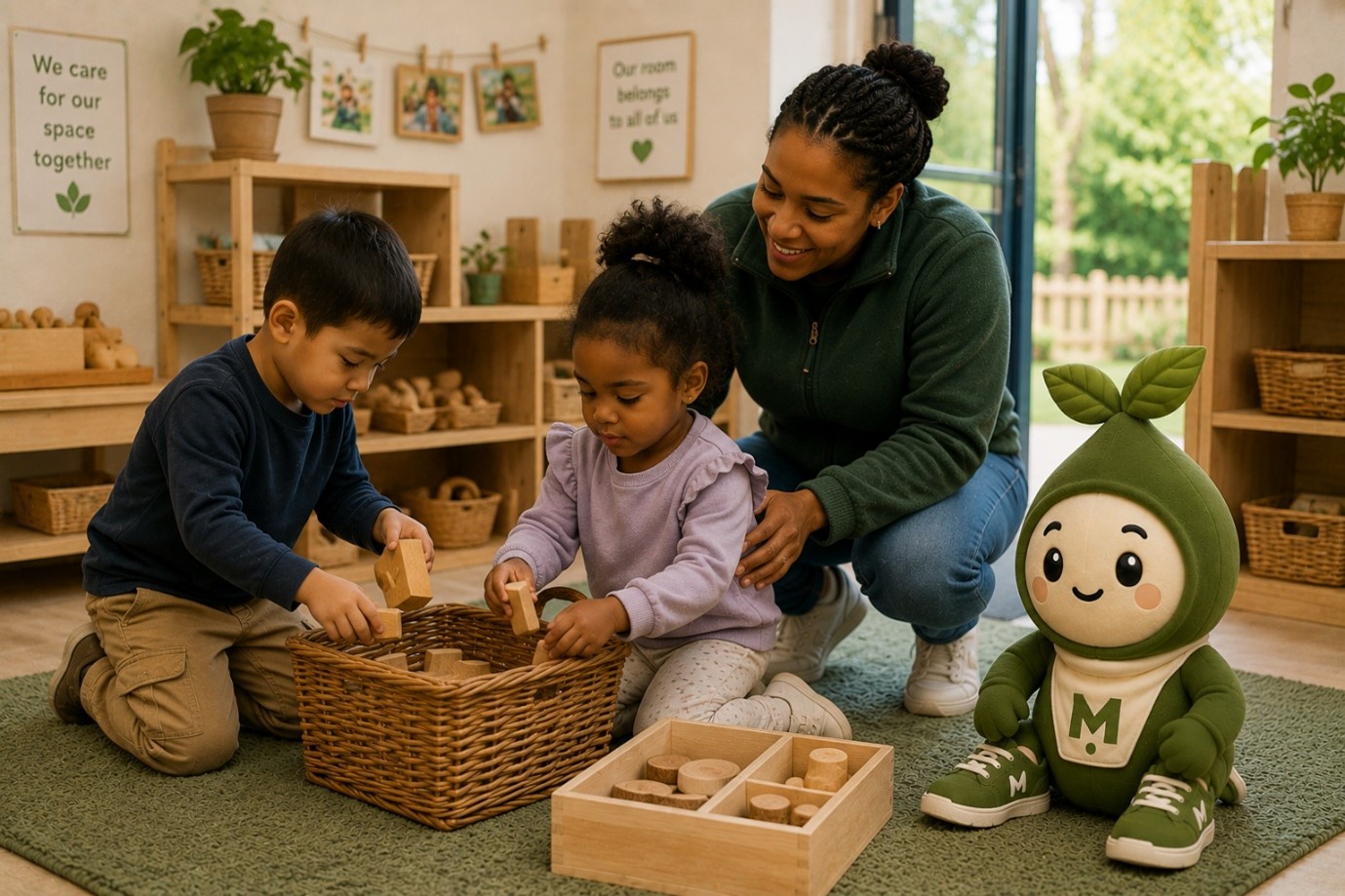
The Power of the Pause: More Than Putting Things Away
Oct 1, 2026

Pause. Notice. Extend. Finding more learning in the everyday.
Over the last four weeks, we have been looking at the ordinary moments of an early years day through a slightly different lens.
We have asked where is the learning hiding?
We have considered what happens before we do it for them.
We have explored why everyday care is more than a routine.
And last week, we looked at transitions and considered whether the journey is learning too.
This week, I want to look at something that happens in almost every early years setting, often several times a day.
Tidying up.
It sounds straightforward.
The children have finished playing.
The resources need putting away.
The room needs resetting.
Then we can move on.
But perhaps there is a problem with that thinking.
Because what if the children haven’t finished?
And what if tidying itself contains considerably more learning than simply putting things back where they belong?
“Right Everyone, Tidy Up!”
Most of us can probably picture it.
The announcement is made.
“Right everyone, it’s tidy-up time.”
Perhaps a song starts playing.
Adults begin moving around the room.
“That goes over there.”
“Put those back in the box.”
“Can you pick those up?”
“Come on, everyone needs to help.”
Some children enthusiastically join in.
Some carry one object around for several minutes.
Some disappear.
And somewhere in the room is usually a practitioner doing the tidying at approximately four times the speed of everybody else.
Eventually, the room is restored.
Everything is back where the adults believe it belongs.
Tidy-up time complete.
But what actually happened?
Who did the thinking?
Who decided where things belonged?
Who organised the resources?
Who solved the problem of fitting everything back into the space?
And did the children understand why they were tidying, or were they simply responding to a series of adult instructions?
There is a difference.
What Does ‘Away’ Mean?
Imagine a child holding a wooden animal.
An adult says:
“Put it away please.”
We know exactly what we mean.
But does the child?
Where is away?
Which container?
Which shelf?
How do they know?
Perhaps they look around.
Perhaps they remember where they found it.
Perhaps they notice other animals in a basket.
Perhaps they compare it with the resources around them.
Suddenly, something apparently simple requires the child to think.
What is this?
What is it similar to?
Where might it belong?
How is this environment organised?
That is categorisation.
Memory.
Matching.
Problem-solving.
Environmental awareness.
And potentially a lot of language.
But if the adult points and says:
“Animals go in that box.”
The child may successfully put the animal away.
But once again:
Who did the thinking?
Tidying Is Part of the Curriculum
We sometimes treat tidying as the thing that happens when the learning has finished.
But look at what children can experience through genuinely participating in caring for their environment.
Sorting.
Matching.
Categorising.
Comparing.
Sequencing.
Problem-solving.
Spatial awareness.
Collaboration.
Communication.
Physical coordination.
Remembering.
Making decisions.
Taking responsibility.
There are mathematical concepts everywhere.
Does this fit?
Which container is bigger?
How can we arrange these so they all go in?
Why won’t the lid close?
Which objects belong together?
Where is there space?
Again, we don’t need to turn tidy-up time into a planned maths activity.
That would rather miss the point.
The learning is already there.
Our role is to notice it.
The Construction That Isn’t Finished
There is another part of tidying that I think deserves considerably more attention.
A child has spent forty minutes constructing something.
They have balanced blocks.
Tested ideas.
Changed the structure.
Added loose parts.
Talked with other children.
Solved problems.
Perhaps they have returned to it several times throughout the morning.
Then comes the announcement:
“Tidy-up time!”
And within minutes, the entire thing is dismantled.
Why?
Because lunch is coming.
Because we’re going outside.
Because the room needs to be tidy.
Because that’s what happens at 11.15.
Sometimes, of course, resources genuinely do need to be moved.
Spaces need to change function.
Safety needs to be considered.
Other children need access.
But perhaps not everything needs to disappear simply because one part of the day has ended.
Before asking a child to dismantle something they have invested significant thought in, perhaps we should pause and ask:
Is this play actually finished?
The Right to Return
Adults are generally allowed to leave things unfinished.
We save a document.
Leave something on our desk.
Put a bookmark in a book.
Return to a task tomorrow.
Children don’t always have that luxury.
Their play can be repeatedly reset for them.
Build it.
Explore it.
Develop it.
And then take it apart because the timetable has moved on.
There can be real value in children being able to return to their thinking.
Perhaps a construction can remain overnight.
Perhaps a sign could show that it is still being used.
Perhaps part of the environment can remain undisturbed.
Perhaps a photograph can help children reconstruct or revisit an idea when leaving it isn’t possible.
The question isn’t whether children should never tidy something away.
It’s whether we automatically assume that the end of a session means the end of the learning.
Because sometimes what looks like mess to an adult is actually thinking that hasn’t finished yet.
Whose Environment Is It?
Tidying also raises an interesting question about ownership.
Early years environments are usually organised by adults.
Adults choose the baskets.
Adults decide what goes on which shelf.
Adults label the containers.
Adults decide where resources belong.
Then we ask children to take responsibility for putting everything back.
But how much ownership have children actually had?
Could children help decide where things belong?
Could they identify which resources should be stored together?
Could they help reorganise a shelf that isn’t working?
Could they notice when a basket is too small?
Could they suggest where something would be easier to access?
Perhaps instead of:
“That doesn’t go there.”
We could sometimes ask:
“Where do you think it should go?”
And then listen to the answer.
Children may organise things differently from us.
That doesn’t automatically mean they’re wrong.
Does Everything Need a Label?
This is also where we need to be thoughtful about our environments.
It can be tempting to solve every organisational challenge with another label or photograph.
Labels can absolutely support children to navigate an environment independently.
But a label shouldn’t replace thinking.
If every object has an exact photograph showing precisely where it must be placed, we need to consider what we are trying to achieve.
Are we supporting children to understand and care for their environment?
Or are we teaching them to reproduce the adult’s organisational system?
Sometimes children need visual support.
Sometimes clear categorisation is useful.
But perhaps there should also be room for children to sort, decide, negotiate and reorganise.
Independence isn’t simply following the adult system without adult help.
“Everyone Needs to Help”
There is also the social element of tidying.
Early years settings are shared spaces.
Learning to contribute to a shared environment matters.
But contribution doesn’t have to mean every child doing exactly the same thing at exactly the same time.
One child might carry baskets.
Another might sort the animals.
Someone might collect books.
Two children might work together to fit large blocks onto a shelf.
A younger child might manage only one or two objects.
For some children, understanding what is expected during a whole-group tidy may be particularly difficult.
The goal shouldn’t simply be compliance.
The goal is meaningful participation.
What can this child contribute?
What responsibility could they manage?
What support would help them understand the process?
Again, participation comes before independence.
When Adults Tidy Around Children
There is something worth observing in almost every setting.
Watch what happens immediately before lunch, home time or another major transition.
Adults can become extremely efficient.
Resources are swept into baskets.
Tables are wiped.
Chairs are moved.
Floors are cleared.
Everything begins returning to order at speed.
Meanwhile, children are still present.
Sometimes even still playing.
We need to ask whether our drive for efficiency is unintentionally communicating:
Caring for the environment is adult work.
Children play.
Adults reset.
Then, when we suddenly ask children to tidy, it can feel like an instruction rather than a natural part of using a shared space.
What if caring for the environment happened throughout the day?
Not obsessively putting away every resource the moment someone stops touching it.
But developing a culture where children increasingly understand:
I use this space.
Other people use this space.
I can help care for it.
That’s bigger than tidy-up time.
A Perfectly Tidy Nursery
We also need to be careful about what we celebrate.
A beautifully organised nursery can look wonderful.
Everything in baskets.
Shelves perfectly arranged.
Nothing out of place.
But early years environments are places where children should be doing things.
Building.
Combining.
Transporting.
Testing.
Creating.
Moving resources between areas.
Following ideas that adults may not have anticipated.
Meaningful play doesn’t always respect our shelving system.
If maintaining the appearance of the environment becomes more important than children’s ability to explore it, something has gone wrong.
Of course, environments need to be safe, accessible and cared for.
But perhaps we should become comfortable with a little evidence that children have actually been there.
Pause. Notice. Extend.
So what might our three questions look like during tidying?
Pause
Before telling a child where something belongs, wait.
Do they know?
Could they work it out?
And before dismantling something:
Is the child actually finished with it?
Notice
Who participates in caring for the environment?
Who avoids tidy-up time?
Which children know where resources belong?
Where are adults doing most of the work?
Which resources are consistently difficult for children to organise?
What play is regularly interrupted because the room needs resetting?
Extend
Could children sort rather than simply put away?
Could they decide how resources should be organised?
Could they work together?
Could we introduce language naturally as problems emerge?
Could a piece of play remain so children can return to it?
Could children take greater ownership of the environment itself?
And sometimes:
Could the adult simply step back and see what the children decide?
Try Not to Tidy
I have a slightly different challenge for leaders this week.
During one tidy-up period, don’t help initially.
Watch.
Not because practitioners shouldn’t support children.
But because stepping back briefly can reveal an enormous amount.
Who knows what to do?
Who begins organising others?
Who sorts?
Who carries?
Who watches?
Who appears completely unsure what tidy up actually means?
Who continues playing because, from their perspective, the play isn’t finished?
Which children collaborate?
And how quickly do adults feel the urge to step in and make the process more efficient?
Then look at the environment.
If children can’t work out where things belong, perhaps the problem isn’t the children.
Perhaps the organisation isn’t working for them.
More Than Putting Things Away
Tidying is necessary.
Resources need caring for.
Shared spaces need maintaining.
Children should increasingly contribute to the environments they use.
But perhaps tidying deserves more thought than:
“Everyone put everything away.”
Because within those few minutes there may be opportunities to sort.
To categorise.
To remember.
To negotiate.
To solve problems.
To collaborate.
To take responsibility.
To make decisions.
And sometimes, the most important decision we make might be not to tidy something away at all.
So the next time we look across the room and think:
“We need to get this place tidy…”
Perhaps we could pause.
Look again.
And ask:
What are we actually tidying away?
Because it might be more than resources.
It might be an idea that isn’t finished yet.
Pause. Notice. Extend.
Next week, we bring The Power of the Pause together and ask the bigger question behind this entire series:
What happens when we stop rushing?
Not just to individual children.
But to our pedagogy, our environments, our teams and ultimately the culture we create for children every day.