
The Power of the Pause: The Journey Is Learning Too
Sep 23, 2026

Over the last three weeks, we have been looking differently at some of the most ordinary moments in an early years day.
We started by asking where is the learning hiding?
Then we considered what happens before we do it for them, and last week we explored why everyday care is more than a routine.
This week, I want to look at something else that happens repeatedly throughout the day.
Moving.
From the room to the garden.
From the garden back inside.
From lunch to sleep.
From one space to another.
From one experience to the next.
We often call these moments transitions.
And sometimes, without really intending to, we treat them as gaps between the important bits.
We finish one thing.
We move the children.
Then the next thing begins.
But what if we stopped thinking about transitions as the space between learning?
What if the journey was learning too?
“Right, Everyone to the Garden”
Picture a familiar nursery moment.
The door opens.
“Right everyone, we’re going outside.”
Children are gathered.
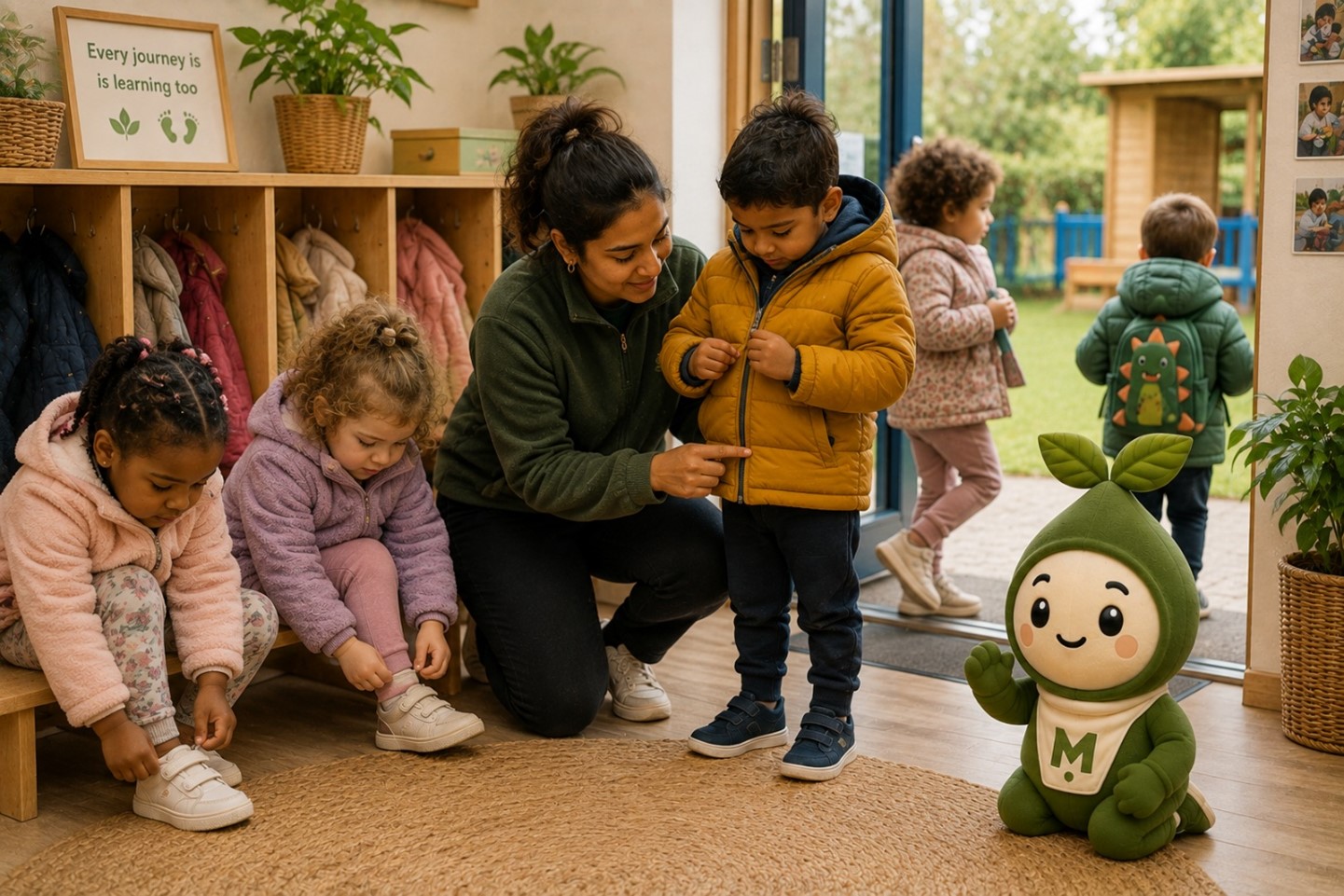
Coats are found.
Adults begin organising.
Someone is looking for a shoe.
Another child has wandered back towards the construction area.
A practitioner is holding the door.
Someone calls:
“Come on everyone!”
Eventually, everyone makes it outside.
Transition complete.
And now the children can get back to learning.
Except…
What happened during those ten minutes?
Because there was potentially an enormous amount.
Children had to listen and respond to information.
They needed to understand that something was changing.
They had to stop what they were doing.
Remember where their belongings were.
Decide what they needed.
Put on clothing.
Wait.
Navigate around other people.
Perhaps help someone else.
Remember where they were going.
And manage the emotional shift from something they were deeply involved in to something completely different.
That isn’t dead time.
That’s a lot to process.
Transitions Are Hard
I think we sometimes underestimate just how much we ask of children when we transition them.
Imagine being completely absorbed in something.
You’re concentrating.
You’ve built something you’re proud of.
You’ve just worked out what you’re going to do next.
Then someone announces:
“We’re going now.”
And within moments, you’re expected to abandon it.
Adults don’t always manage that particularly well either.
Yet children may experience this repeatedly throughout their nursery day.
Tidy up.
Snack.
Garden.
Inside.
Lunch.
Sleep.
Wake up.
Outside again.
Home time.
Of course, routines and organisation are necessary.
But we should perhaps ask ourselves:
How many transitions have we created because children need them, and how many exist because our timetable says they should?
Does Everyone Need to Move?
This is one of my favourite questions when looking at nursery organisation.
Does everyone actually need to move at the same time?
Sometimes they do.
There will always be moments where staffing, ratios, safety or the organisation of the environment means a group needs to transition together.
But sometimes the answer is:
Not really.
Perhaps a child is completely engrossed in building.
Perhaps another child is halfway through a conversation with a practitioner.
Perhaps someone has only just settled into an experience.
Do they need to stop because the clock says it is time for the garden?
Could some children go first?
Could others follow?
Could the transition be more fluid?
Could access to different spaces be organised differently?
Could the experience continue somewhere else?
These aren’t simply operational questions.
They are pedagogical questions.
Because every time we interrupt children’s thinking, we make a decision about what we value.
The Long Line to Nowhere
There is another feature of transitions worth watching.
Waiting.
Children waiting by doors.
Waiting in lines.
Waiting for everyone to finish washing their hands.
Waiting for the last coat to be zipped.
Waiting for an adult to count everyone.
Waiting for another group to move.
Sometimes waiting is unavoidable.
But sometimes it exists because that’s simply how we’ve always organised the routine.
And when children find waiting difficult, what happens?
“Stand still.”
“Wait there.”
“Don’t touch that.”
“We’re nearly ready.”
“Just wait.”
Then we can find ourselves describing children as unsettled during transitions.
Perhaps they aren’t unsettled.
Perhaps they’re just waiting too long.
If a transition repeatedly requires children to stand doing nothing while adults organise the environment around them, the question shouldn’t only be:
“How do we get the children to wait better?”
Perhaps it should also be:
“Why are we asking them to wait?”
Look What We Walked Past
But there is another side to transitions.
Sometimes the journey itself offers something.
A child walking towards the garden notices a shadow across the floor.
Someone hears an aeroplane.
A child stops because there is a tiny insect near the doorway.
Another notices that yesterday’s puddle has disappeared.
Someone feels the wind as the door opens.
A child spots their reflection in the glass.
And what do we sometimes say?
“Come on.”
“We’re going outside.”
“Keep moving.”
Because in our minds, the destination is where the experience is going to happen.
The garden is where the learning is.
Except the child has just found something fascinating on the way to it.
This is where the pause matters.
Could we stop?
Could we look?
Could we listen?
Could we wonder together?
Could the destination wait thirty seconds?
Not every observation needs to become a conversation.
Not every insect requires a mini-beast investigation.
But sometimes children show us exactly where their thinking is.
Are we moving too quickly to notice?
A Transition Is Still Part of the Curriculum
If our curriculum is everything we want children to experience, learn and increasingly understand, transitions cannot sit outside it.
Think about what children can develop through moving around their environment.
Understanding routines.
Anticipating what happens next.
Managing belongings.
Making choices.
Following routes.
Recognising environmental cues.
Developing positional language.
Negotiating space.
Supporting other children.
Remembering information.
Developing self-regulation.
Becoming increasingly independent.
There are opportunities for language too.
Through.
Around.
Behind.
Next to.
Under.
Over.
First.
Next.
After.
Before.
But again, I don’t want us to turn walking to the garden into a planned maths lesson.
That’s not the point.
We don’t need to manufacture learning when authentic learning is already happening.
What Are We Rushing Towards?
There is a wider question here about pace.
Early years settings can become incredibly busy places.
Not necessarily because children need them to be busy, but because adults have created a busy timetable.
At 9.30 we do this.
At 10.00 we do that.
At 10.30 everyone moves.
At 11.15 we tidy.
At 11.30 we prepare for lunch.
Organisation matters.
But there is a danger that the timetable begins driving the pedagogy rather than supporting it.
When that happens, adults spend large parts of the day moving children towards whatever is supposed to happen next.
And the language begins to reflect it.
“Come on.”
“Quickly.”
“We need to go.”
“Hurry up.”
“Everyone ready?”
Perhaps one of the most useful questions we can ask is:
What are we rushing towards?
And is it more valuable than what is happening right now?
Sometimes the answer will genuinely be yes.
Lunch is arriving.
A child needs changing.
Staff need to move.
Safety requires it.
But sometimes…
We’re rushing because the timetable says so.
The Child Who Needs More Time
Transitions also remind us why knowing individual children matters.
For some children, moving from one experience to another is relatively straightforward.
For others, transitions can be significant.
A child may need more warning.
More time.
A visual cue.
A familiar object.
An adult alongside them.
A clear understanding of what will happen next.
An opportunity to finish what they are doing.
Or perhaps a role within the transition itself.
“Could you take this outside for us?”
“Can you help me check what we need?”
“Would you like to carry your boots?”
The goal isn’t simply to make children comply with transitions more efficiently.
It is to understand what helps this child move successfully from one experience to another.
That’s a very different starting point.
Pause. Notice. Extend.
So how might we apply our three questions to transitions?
Pause
Before calling everyone to move, ask:
Does everyone need to transition now?
Could someone have another minute?
And when a child notices something along the way, do we always need to keep moving?
Notice
Who manages transitions confidently?
Who regularly finds them difficult?
Where does most of the waiting happen?
What are children noticing as they move?
Which routines require the most adult direction?
Where are children being interrupted unnecessarily?
Extend
Could children take greater responsibility?
Could transitions happen in smaller groups?
Could we reduce waiting?
Could children anticipate and prepare for what comes next?
Could we follow something they’ve noticed along the journey?
Could we alter the routine rather than continually trying to alter the child’s response to it?
Follow the Children
This week, I would encourage leaders to do something very simple.
Choose a group of children and follow them through one transition.
From the moment the transition is announced until the moment they are meaningfully engaged again.
Time it if you want to.
Notice how often adults give instructions.
Notice how much children wait.
Notice what children have to stop doing.
Notice what they try to do for themselves.
Notice what they see along the way.
And notice how long it takes before they are genuinely engaged again.
Then ask:
Did this transition work for the children, or did the children have to work for the transition?
Perhaps We Don’t Need to Get There So Quickly
Early years isn’t simply a sequence of destinations.
Breakfast.
Activity.
Garden.
Lunch.
Sleep.
Outside.
Home.
Children experience everything that happens between those points too.
The coat that won’t fasten.
The friend who needs help.
The puddle outside the doorway.
The noise coming from somewhere above them.
The challenge of leaving something unfinished.
The excitement of knowing what is coming next.
The frustration of waiting for everybody else.
The growing confidence of knowing where to go without being told.
These moments matter.
So next time we’re halfway through saying:
“Come on, we’re going…”
Perhaps we could pause.
Look at what the child is looking at.
Notice what they are doing.
And ask ourselves:
Do we really need to get there quite so quickly?
Because sometimes the most interesting learning isn’t waiting for us at the destination.
It’s happening on the way.
Pause. Notice. Extend.
Next week, we’ll explore another routine that can very quickly become adult-led: tidying up.
Because perhaps tidying isn’t simply about putting everything back where it belongs.
Perhaps the way children sort, organise, categorise, remember, negotiate and take responsibility for their environment deserves a pause too.
| Pause. Notice. Extend.
Because sometimes the most interesting learning isn’t waiting for us at the destination. It’s happening on the way. |