
The Power of the Pause: Before You Do It for Me
Sep 11, 2026
Last week, I introduced The Power of the Pause and asked a simple question: where is the learning hiding?
We considered the moments that sit between the experiences we traditionally recognise as learning. Washing hands, getting ready, moving around the setting, preparing for sleep, tidying away.
The everyday things.
This week, I want to explore something that can be considerably harder to change.
Our instinct to help.
Early years practitioners are caring people. We see a child struggling and naturally want to make things easier.
A coat won’t fasten, so we zip it up.
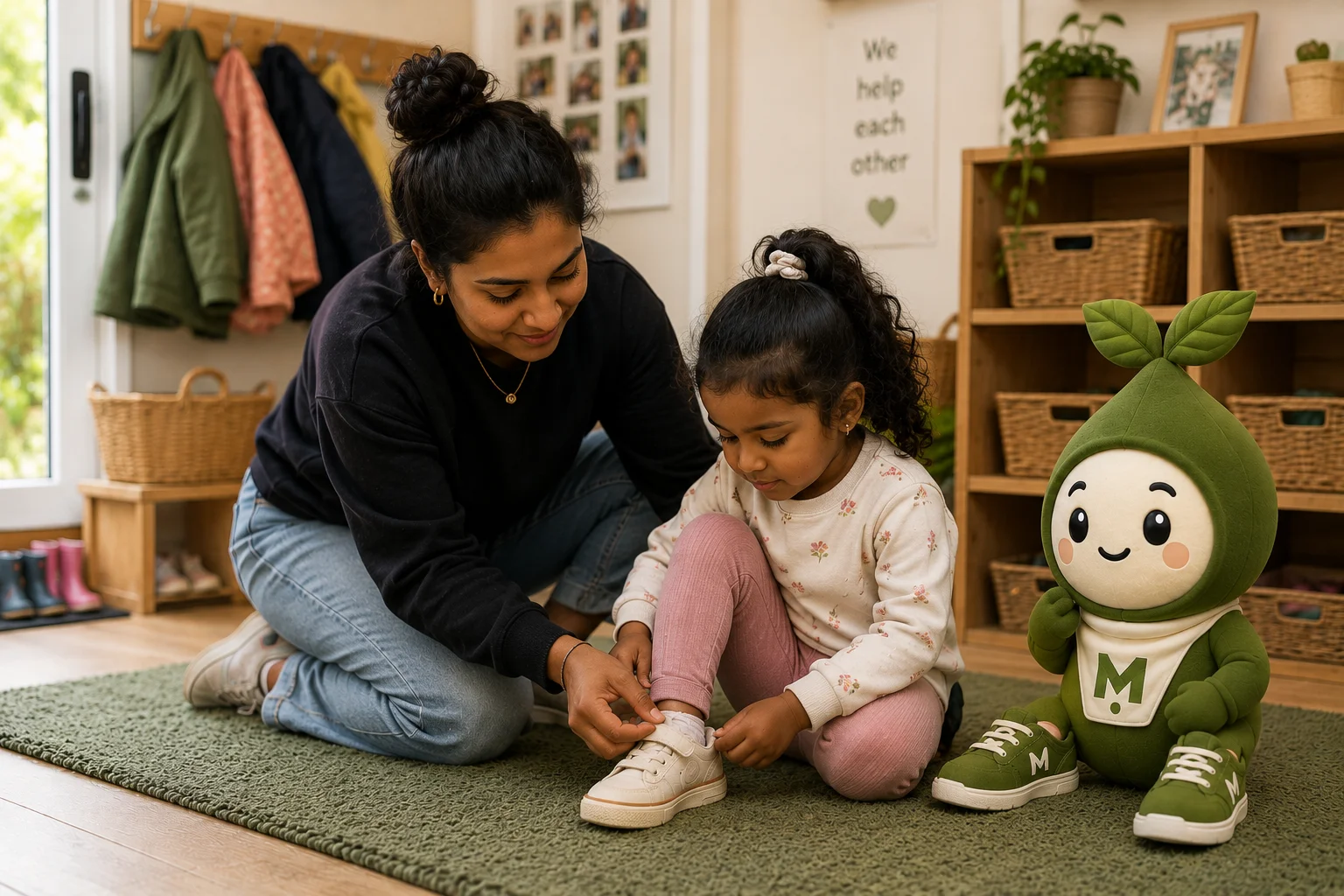
A shoe is on the wrong foot, so we swap it.
A child can’t quite stretch their sheet across their bed, so we pull the corner over.
Something spills, so we reach for the cloth.
A child can’t open something, so we open it.
None of these actions are wrong.
But perhaps there is a question worth asking before we step in:
Could the child do more here?
When Helping Becomes Doing
There is a phrase most of us will have heard, and probably used:
“It’ll be quicker if I do it.”
And usually, it will.
Anyone who has watched a toddler attempt to put on a coat when you needed to be outside five minutes ago will understand that.
Early years settings are busy places. There are routines to manage, ratios to maintain, meals arriving, sleep times, transitions and a hundred other things happening simultaneously.
Efficiency matters.
But if efficiency always wins, what opportunities are children losing?
A practitioner can put a child’s coat on in seconds.
The child may take several minutes.
Those minutes aren’t wasted.
They are trying to identify which way the coat goes. Finding the sleeves. Coordinating their arms. Pulling material into position. Working out what has become twisted. Locating the zip. Holding one side steady while manipulating the other.
And, quite possibly, experiencing the frustration of it not working immediately.
That’s a lot of learning contained within something we might simply describe as:
Getting ready for the garden.
Making the Bed
One of my favourite examples of this is preparing children’s sleep spaces.
Imagine an adult making ten beds.
They know exactly what they’re doing. Sheets are unfolded, stretched over mattresses and straightened. Blankets or sleep bags are placed ready.
Efficient. Organised. Done.
Now imagine children being involved.
One child collects their bedding.
Another unfolds a sheet.
A child pulls one corner over their mattress before discovering that the opposite corner no longer reaches.
They try again.
The sheet comes off.
They pull harder.
Another child holds the opposite side.
Suddenly, making a bed isn’t simply preparation for sleep.
There is coordination, strength, spatial awareness, sequencing, problem-solving, communication, collaboration and perseverance.
And there is something else:
Ownership.
This is my sleep space.
I helped prepare it.
Later, when sleep time finishes, there is another opportunity.
Can the child remove the sheet?
Where does it go?
Can they fold or gather it?
Can they carry it?
Can they help return the sleep space to its usual purpose?
We don’t need to invent learning around these moments.
We simply need to stop removing children from them.
Participation Before Independence
This is where I think we need to be careful with the word independence.
Sometimes we inadvertently create an all-or-nothing expectation.
Either the child can do something independently or the adult does it for them.
But there is an enormous space between those two points.
A baby might hold out an arm while being dressed.
A toddler might carry their own sleep bag.
Another child might pull their sheet from the mattress but need help folding it.
A child might put their coat on but need support starting the zip.
Another might carry their plate but need an adult alongside them.
Children don’t need to be able to complete the whole task before they can participate in it.
Participation comes before independence.
And participation looks different depending on the child.
The question isn’t:
“Can they do this by themselves?”
It is:
“Which part of this could they do?”
That small change in thinking can significantly alter the role of the adult.
But They’re Struggling
This is perhaps where the pause becomes most important.
A child is trying to put their shoe on.
It isn’t working.
We see the struggle.
Our instinct is to help.
But struggle isn’t necessarily something we need to remove immediately.
There is a difference between a child who is becoming overwhelmed and a child who is working something out.
The practitioner needs to know the child well enough to recognise that difference.
A furrowed brow doesn’t automatically mean:
“Do it for me.”
Sometimes it means:
“I’m thinking.”
Sometimes children need a little longer than we are comfortable giving them.
They turn something around.
Try another way.
Watch another child.
Stop.
Start again.
Ask for help.
That process matters.
If we step in at the first sign of difficulty, the child learns something too:
When something becomes difficult, an adult will solve it.
Our intention was to help.
But what did the child experience?
The Power of ‘Yet’
Pausing doesn’t mean standing silently while a child becomes increasingly frustrated.
Nor does independence mean withdrawing adult support.
Our role is still incredibly important.
The difference is that support can be responsive rather than automatic.
A child can’t manage the zip.
Yet.
Could I hold the bottom while they pull?
Could I model how the two pieces fit together?
Could I position their hands?
Could another child demonstrate?
Could I begin the process and let them finish?
Could I simply say, “You’ve nearly got it,” and give them another few seconds?
This is scaffolding.
We provide enough support for the child to remain involved without taking ownership of the task away from them.
And as their competence increases, our support reduces.
Be Careful With the Question
There is another way adults can unintentionally take over.
We don’t physically complete the task.
Instead, we provide a running commentary of instructions.
“Put your arm in there.”
“Now the other one.”
“Turn it around.”
“Pick that bit up.”
“Pull it.”
“No, the other way.”
“Put it there.”
The child’s hands may be doing the task, but who is doing the thinking?
This is where Pause. Notice. Extend. becomes useful again.
Pause
Before giving the next instruction, wait.
Does the child actually need it?
Notice
What are they trying?
What do they already understand?
Are they looking for a solution?
Are they watching someone else?
Are they asking for support?
Extend
What is the smallest amount of support that would help them move forward?
Sometimes that’s a question.
Sometimes it’s modelling.
Sometimes it’s positioning something slightly differently.
Sometimes it’s doing one part together.
And sometimes it is simply allowing more time.
The Perfectly Made Bed
There is another challenge for adults in all of this.
We often have a picture in our heads of what the finished task should look like.
The bed should be neat.
The resources should be perfectly returned.
The coat should be zipped right to the top.
The table should be wiped properly.
The shoes should be on the correct feet.
And of course there are times when something needs correcting for safety, comfort or hygiene.
But sometimes we need to ask:
Whose standard are we trying to achieve?
A three-year-old’s attempt at making their bed probably won’t look like an adult made it.
That’s okay.
We can support them to make sure the sheet is secure and their sleep space is safe and comfortable without taking over the entire process.
If the only acceptable outcome is an adult-standard finish, adults will inevitably end up doing most of the work.
The process matters too.
What Are the Adults Doing?
There is a useful exercise for leaders here.
Choose one routine.
Getting ready for the garden.
Preparing beds.
Clearing lunch.
Putting belongings away.
Don’t initially watch the children.
Watch the adults.
How often do they step in?
How long do they wait before helping?
What tasks are they completing that children could participate in?
How much instruction are they giving?
When a child struggles, what happens next?
And perhaps most importantly:
Are practitioners under pressure to complete the routine so quickly that meaningful participation becomes unrealistic?
Because this isn’t simply about practitioner behaviour.
Leaders create the conditions in which practice happens.
If ten children need to be outside immediately because the timetable says garden time begins at 10.15, we shouldn’t be surprised when adults put ten coats on as quickly as possible.
Sometimes enabling children to do more requires us to examine the expectations, routines and pace we have created around them.
Doing With, Not Doing For
There will always be things adults need to do for children.
There will also be moments when time, safety, children’s individual needs or circumstances mean an adult needs to step in.
The Power of the Pause isn’t about creating a rule that adults must never help.
It is about making helping intentional.
Before automatically completing something, ask:
Could the child participate?
Before giving the answer:
Could they work something out?
Before correcting:
Does it actually need correcting yet?
Before giving another instruction:
Could I wait?
Before doing it for them:
Could we do it together?
Because independence doesn’t suddenly appear when children reach a particular age.
It grows through hundreds of small opportunities to participate.
To try.
To struggle a little.
To solve problems.
To contribute.
To experience success.
And to discover:
I can do more than I thought I could.
Sometimes our job is to help.
Sometimes our job is to show.
And sometimes our job is simply to pause long enough for the child to have a go.
Formatting/layout version — wording retained exactly as supplied.