
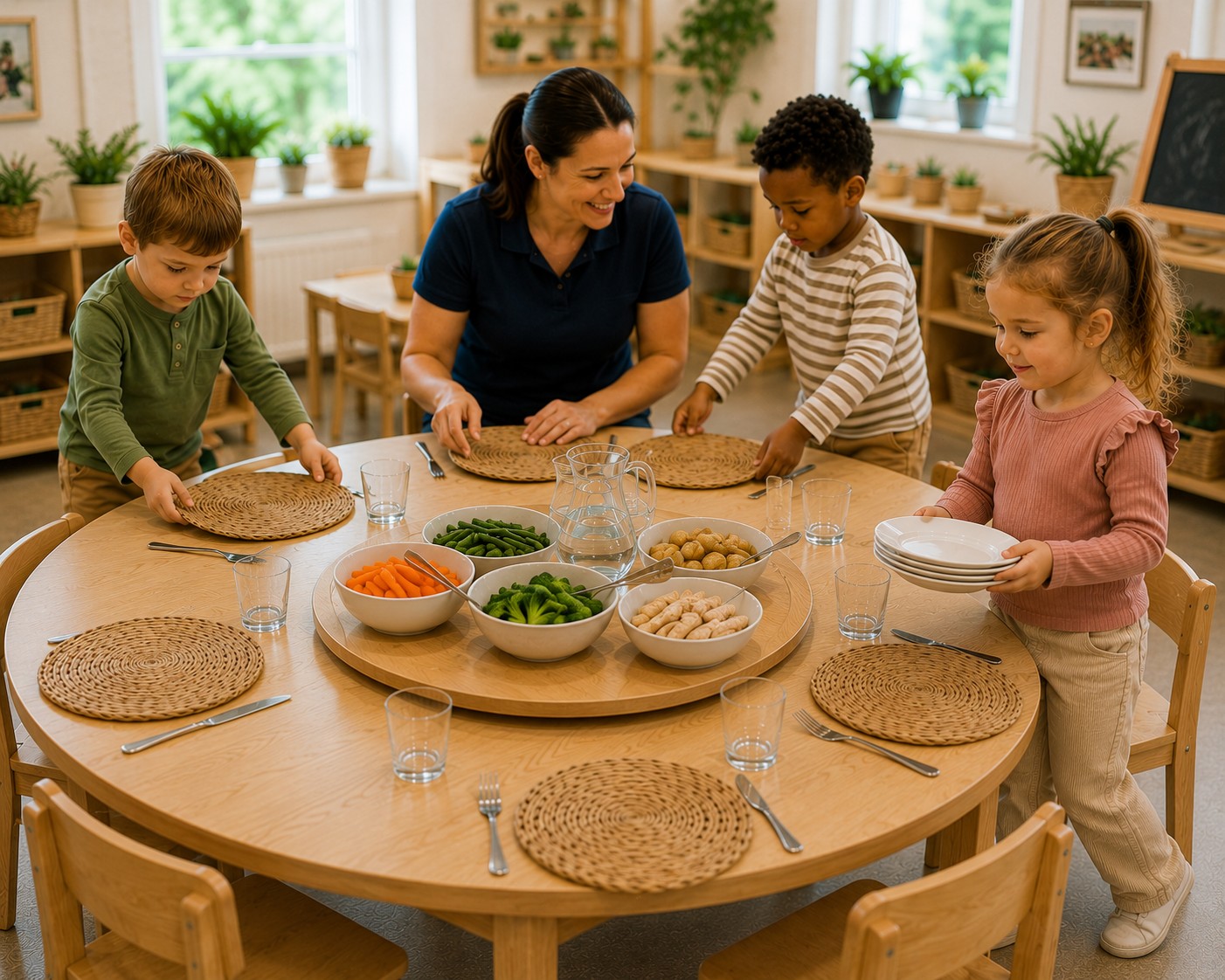
From Transaction to Teaching: Making Every Mealtime Count
Aug 13, 2026

Most nursery leaders recognise the importance of healthy eating.
Many invest significant time reviewing menus, ensuring food is nutritious, allergies are managed effectively and children are supervised appropriately.
Yet one question is often overlooked.
What are children actually learning during mealtimes?
For many settings, mealtimes have gradually become something to “get through.”
Clear the tables.
Wash hands.
Sit children down.
Serve food.
Clear away.
Move on to the next activity.
Before long, what should be one of the richest learning opportunities of the day has become little more than an operational task.
Perhaps it is time to slow down.
Mealtimes Are Part of Your Curriculum
Children don’t stop learning because lunch arrives.
In many ways, they learn even more.
Communication.
Independence.
Turn taking.
Patience.
Social interaction.
Mathematics.
Physical development.
Problem solving.
Self-care.
Confidence.
Belonging.
Every meal presents opportunities that simply cannot be recreated through an adult-led activity.
The question for leaders is whether practitioners are recognising them.
Independence Starts Much Earlier Than We Often Think
Self-service should not suddenly appear in the preschool room.
It begins long before that.
Even babies benefit from watching practitioners serve food thoughtfully.
Narrating what they are doing.
Talking about quantities.
Naming foods.
Showing children how meals are prepared.
Children begin to understand routines long before they are physically able to participate independently.
As confidence develops, practitioners can begin introducing shared responsibility.
Around 18 months, many children can begin serving alongside an adult using a hand-over-hand approach.
Not because we expect perfection.
But because confidence develops through repeated opportunities.
By the time children reach the toddler room, many are capable of serving appropriate portions with adult guidance.
By preschool, children can often:
- Set the table.
- Carry their own plate safely.
- Pour drinks.
- Serve themselves.
- Pass bowls to friends.
- Help tidy away.
- Support younger children.
- Talk confidently about healthy choices.
These are not simply nursery routines.
They are life skills.
Slow Down to Speed Up Learning
One of the biggest barriers to meaningful mealtimes is pace.
Adults are often thinking about the next routine before the current one has finished.
Children sense this.
Learning becomes secondary to efficiency.
Instead, consider asking practitioners:
“If lunch lasted five minutes longer, what learning opportunities would we gain?”
Often those extra moments create the richest conversations.
Children compare foods.
Describe textures.
Solve problems.
Help one another.
Share family experiences.
Negotiate.
Laugh together.
Build relationships.
None of these require additional resources.
Only time.
Rethinking Transitions
Sometimes the biggest improvements don’t happen during the meal itself.
They happen before it even begins.
Large groups waiting to wash their hands.
Children sitting for extended periods waiting for others.
Staff preparing the room whilst children become restless.
These moments are often accepted as normal.
But they don’t have to be.
Could smaller groups move through routines more smoothly?
Could children continue meaningful learning whilst others prepare for lunch?
Could table preparation become part of children’s responsibilities?
Could transitions become calmer because fewer children are waiting?
Reducing waiting time isn’t simply about behaviour.
It respects children’s time.
Every Practitioner Has a Role
The strongest mealtimes rarely happen by chance.
They happen because adults understand their role.
Who remains seated throughout the meal?
Who supports self-service?
Who replenishes food?
Who notices when a child needs encouragement?
Who joins conversations rather than supervising from a distance?
Clear deployment allows practitioners to focus on children rather than logistics.
Questions for Leaders
Walk through your next mealtime and ask yourself:
- Are adults leading the routine, or learning alongside children?
- Are practitioners rushing towards the next part of the day?
- What opportunities for independence are children genuinely given?
- Are transitions calm or characterised by waiting?
- Do all children experience the same quality regardless of which room they are in?
- If an unfamiliar visitor watched this mealtime, would they describe it as care or education?
Because the answer should always be both.
Final Reflection
Children will probably not remember what was on the menu three weeks ago.
They will remember how mealtimes felt.
Whether they were trusted.
Whether they were listened to.
Whether they belonged.
Whether adults slowed down enough to notice them.
Perhaps the greatest question leaders can ask isn’t, “Did children eat their lunch?”
It’s,
“What did children learn because we shared that meal together?”