
Transitions
Feb 17, 2026
Are We Preparing Children for School… or for Life?
A research-informed reflection grounded in practice in England
Walking around early years settings, coaching leaders, and talking with practitioners, one question comes up time and again:
“Are we preparing children for school, or equipping them with the skills they need for life?”
It’s an understandable question. Leaders are balancing accountability, transition expectations, baseline pressures and parental anxieties, often all at once. But when we pause and look beyond checklists and outcomes, and instead consider what research tells us about effective preparation, a different picture begins to emerge.
One that is less about what children can do on paper, and more about how they manage themselves, relate to others and engage with the world around them.
What the research in England really tells us
Communication comes first — not formal teaching
UK research is clear: communication and language are foundational.
The Education Endowment Foundation (EEF) consistently identifies communication and language approaches as having a strong positive impact in the early years, supporting later literacy, learning behaviours and social outcomes. High-quality interactions sustained shared thinking and meaningful conversation are not “add-ons”, they are core practice.
National EYFSP data shows that while outcomes have improved over time, a significant number of children still do not reach expected levels in communication and language by the end of Reception. This tells us that focusing on talk, vocabulary and understanding remains essential, not just for school readiness, but for long-term learning and inclusion.
When children can explain, question, negotiate and express emotions, they are better equipped to access every area of learning that follows.
Self-regulation predicts success far beyond Reception
Self-regulation, the ability to manage emotions, attention and behaviour, is firmly embedded within the EYFS and Development Matters guidance in England.
Research summarised by the EEF shows that approaches supporting self-regulation and executive function can lead to positive gains in learning and behaviour when embedded consistently.
In practice, this looks like children learning to:
- wait and take turns
- cope with disappointment
- return to learning after a setback
- manage transitions and change
These skills are developed through predictable routines, emotionally available adults and co-regulation — not through correction alone. They are also closely linked to later academic success, wellbeing and resilience.
Social and emotional development underpins learning
UK and international research consistently show that social and emotional skills are closely linked to positive educational and life outcomes.
In England, Reception teachers regularly report concerns around children’s listening, emotional regulation and social interaction on entry to school. These are not behaviour issues to “fix”, but developmental skills to nurture.
Children who feel secure, understood and confident are more able to:
- engage with learning
- form friendships
- take risks and try new things
How a child feels in an environment directly affects how they learn within it.
Play is learning — and it isn’t optional
Play-based learning is not a soft option.
The EEF recognises play as having a positive impact on early learning when adults are intentional in how they support and extend it. UK guidance is explicit: young children learn best through experiences that are active, meaningful and rooted in their interests.
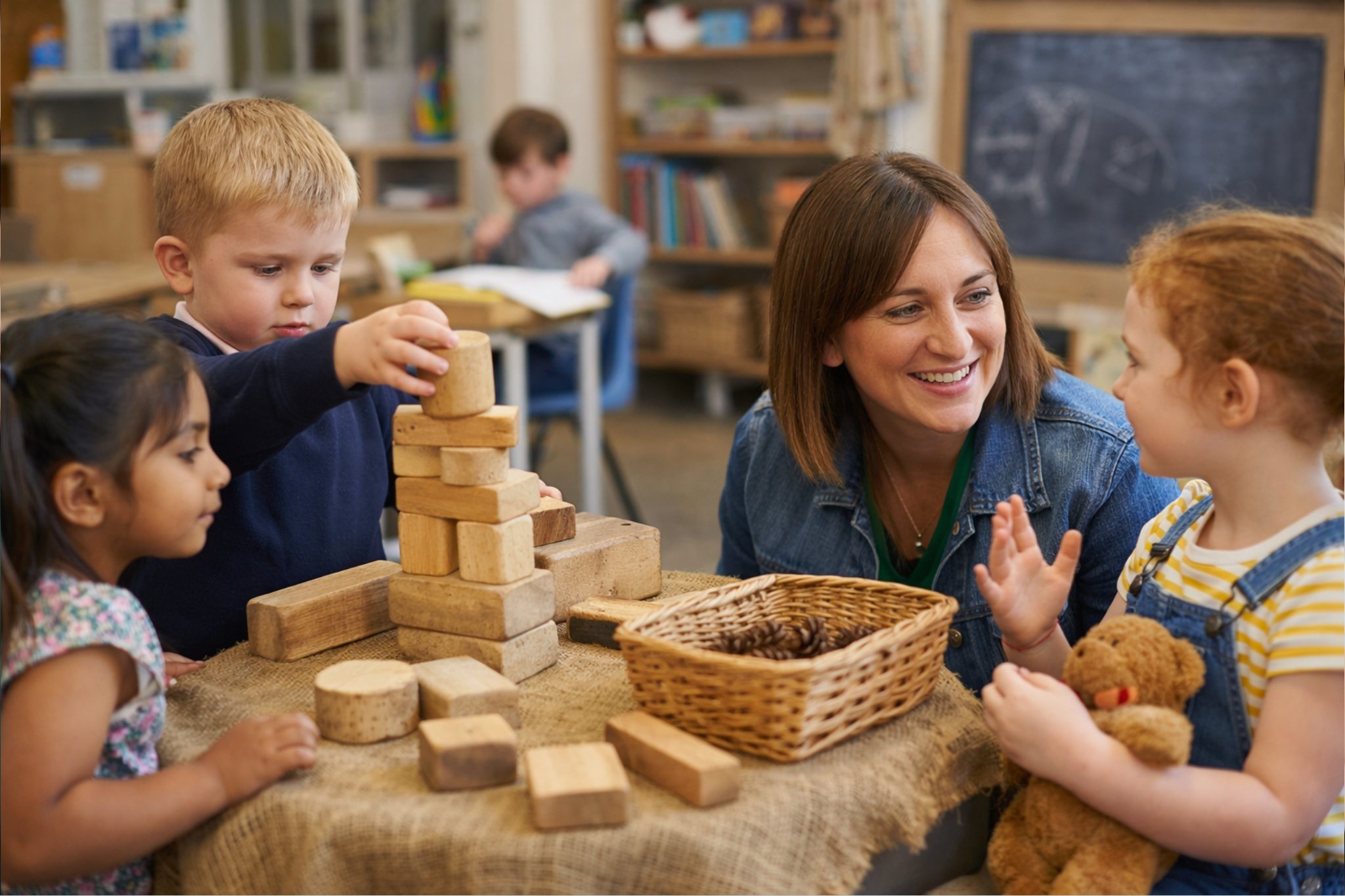
Through play, children practise communication, problem-solving, self-regulation and collaboration, all skills that prepare them not just for school, but for life.
What this means in everyday practice
When we apply this research lens, important shifts in thinking occur.
From:
“Can they sit and listen?”
To:
“Can they communicate, engage and sustain attention in meaningful contexts?”
From:
“Can they write their name?”
To:
“Can they manage frustration, ask for help and keep trying?”
From:
“Are they being formally taught?”
To:
“Are their brains being strengthened through relationships, play and motivated exploration?”
These shifts don’t require more content, they require clarity of intent.
The power of everyday moments
Some of the most powerful indicators of readiness happen quietly:
- a child persevering with a tricky zip
- negotiating roles during play
- carrying their own tray confidently
- using words instead of behaviour to express disappointment
These moments are not small. They are children developing:
- executive function
- communication networks
- emotional regulation
- independence and self-belief
All of which are strongly linked to long-term success.
A different way of thinking about readiness
School readiness is not a checklist to complete.
It is a profile of capabilities built through:
- secure relationships
- rich communication
- independence
- emotional security
- play
Children who enter school with these foundations are more likely to thrive academically, socially and emotionally over time.
In England, around two-thirds of children achieve a Good Level of Development by the end of Reception, reinforcing the importance of focusing on foundations, not just outcomes.
Leadership reflection — what are we prioritising?
For leaders and teams, useful questions include:
- Are we strengthening language across routines, not just during planned activities?
- Is self-regulation supported through predictable environments and calm adult responses?
- Are adults extending learning within play rather than interrupting it?
- Do our routines build independence, or unintentionally create dependency?
- Can staff confidently articulate why this approach matters?
These are not questions about doing more, they are about doing what matters most.
Please click HERE for our Free Download “Transitions Reflection Toolkit”
A shared journey with families
Children live in two key worlds before school: home and setting.
When families and early years provision are aligned in what they value, communication, confidence, emotional strength and independence, children benefit most. Partnership working is not an add-on; it is central to children’s success.
Please click HERE for our Free Download “Transitions Family Handout”
Final thought
Early years is not a waiting room for school.
It is a developmental springboard for life, and the research in England supports this unequivocally.
When we focus on building children’s capacities, rather than ticking off outcomes, we give them not just the best start to school, but the best start to life.
Marathon Early Years Consultancy – Supporting a life-ready approach
At Marathon Early Years Consultancy, our work is rooted in evidence and sharpened by experience. We support leaders and teams to:
- embed communication and interaction as core practice
- strengthen self-regulation through intentional environments
- align play-based curriculum design with life-ready foundations
- build meaningful partnerships with families
Because sustainable early years success, like children’s development, is a marathon, not a sprint.